Generate GIR XML
GIR.WTF converts structured user-controlled GIR information into the technical XML structure expected in the GloBE Information Return workflow. Users work through guided input, not manual XML editing.
GIR XML software
GIR.WTF is software for generating, validating and exporting GloBE Information Return (GIR) XML files for Pillar Two reporting workflows. The user controls the underlying tax and reporting information; GIR.WTF handles technical preparation, schema validation, Belgian technical checks and XML export.
GIR.WTF handles the technical layer. The user and their advisers remain responsible for the underlying tax and legal positions, the reporting information and the final filing decisions.

Technical workflow
The public promise is deliberately narrow: structure user-controlled GIR information, generate XML, run technical validation, resolve visible issues and prepare export for the next controlled workflow.
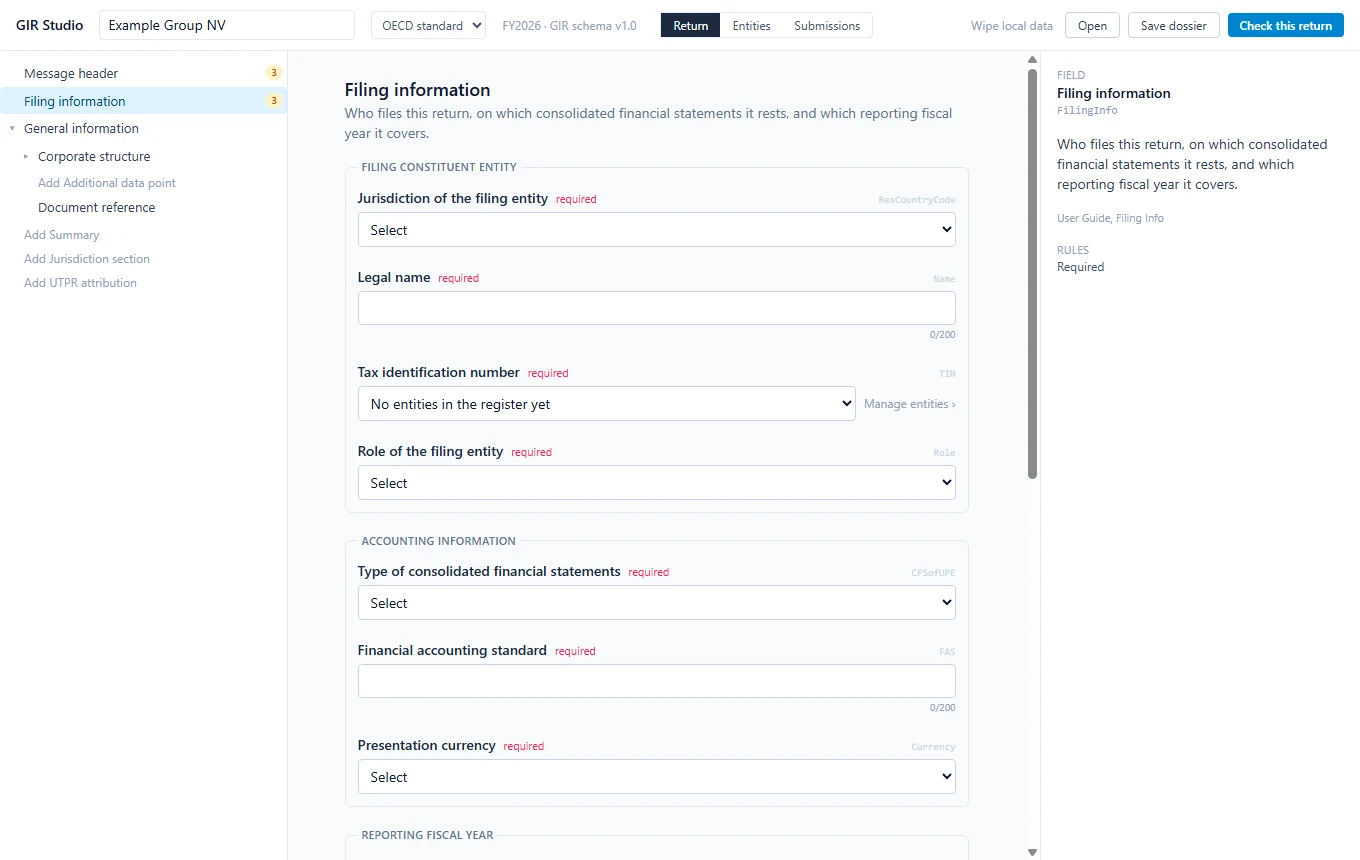
What GIR.WTF does
GIR.WTF combines guided GIR XML generation, browser-based technical validation, schema mapping, Belgian technical checks and XML export in one focused product workflow.
GIR.WTF converts structured user-controlled GIR information into the technical XML structure expected in the GloBE Information Return workflow. Users work through guided input, not manual XML editing.
The workflow checks supported technical structure, required fields, data formats and visible consistency issues before export. The public validator shows how messages point back to the field or data gap that needs review.
Belgian filing introduces its own technical materials and validation expectations. GIR.WTF keeps those implementation checks separate from tax interpretation or filing-position decisions.
The software prepares a technically structured GIR XML output for review and the next filing workflow. GIR.WTF is not MyMinfin, not a tax authority and not a filing guarantee.
Official sources
GIR.WTF is implementation software. OECD and FPS Finance remain the authoritative sources for the GIR XML schema, Belgian materials and official filing context.

Practical questions
Each focused GIR XML page starts from a concrete implementation problem: generating XML, validating structure, mapping the OECD schema, preparing Belgian context or reviewing validation-error behaviour.
Start with structured GIR input, then map reporting-period, entity and jurisdiction data into XML-ready output.
Continue to the related workflowTechnical validation catches malformed XML, missing fields, namespace problems and supported format issues before export.
Continue to the related workflowBelgian implementation work often involves FPS Finance materials, Belgian validation rules and MyMinfin context in the same review path.
Continue to the related workflowImplementation evidence
The public pages show the same boundary as the product: official sources define the schema and Belgian filing context; GIR.WTF provides the technical workflow around structured input, validation messages and export preparation.
The hub, generator, validator, schema, Belgium and validation-error pages each connect practical implementation questions with source-linked context and clear next workflow steps.
Teams preparing 2026 GIR XML work should verify the current OECD schema and user-guide source first. GIR.WTF adds a guided implementation layer around mapping, validation and export.
FPS Finance forms, tools, XSD and validation-rule materials are linked as official sources. GIR.WTF keeps Belgian implementation checks separate from tax advice or filing guarantees.
The browser demo exposes missing technical fields, malformed XML, unsupported document shape and format issues without sending pasted XML to the server.
Generator, validator, schema, Belgian validation rules, GIRNOT Belgium and MyMinfin notification preparation all resolve into the central GIR XML workflow.
GIR XML workflow
The GIR XML hub connects the practical implementation paths: generation, validation, schema readiness, Belgian technical context, GIRNOT, MyMinfin and validation-error detail.
Related implementation questions
These pages cover the common entry points for teams looking for GIR XML validation errors, OECD schema implementation, Belgian validation rules, GIRNOT and MyMinfin notification preparation.
GIRGIR means GloBE Information Return in Pillar Two. gir.wtf explains the Belgian GIR, GIRNOT, MyMinfin and GIR XML workflow for XML-ready review output. No tax or legal advice.
Belgian GIR validation rulesBelgian GIR validation rules page for Pillar Two teams preparing GloBE Information Return XML, GIR XSD checks, data gaps and reviewer-friendly validation output. No tax or legal advice.
GIRNOT BelgiumGIRNOT Belgium portal intake for the notification of the GIR filing entity: MyMinfin preparation, filing entity data checks and GIR/GIRNOT validation support. No tax or legal advice.
Pillar 2 GIR BelgiumPillar 2 GIR Belgium portal workflow for Belgian groups preparing GloBE Information Return data, GIRNOT scope, MyMinfin context and OECD GIR/XML validation. No tax or legal advice.
OECD GIR XML schemaOECD GIR XML schema 2026 readiness for Pillar Two teams: guided GIR data capture, XSD validation checks, XML export preparation and data gap review. No tax or legal advice.
MyMinfin GIR notificationMyMinfin GIR notification preparation for Belgian Pillar 2 teams: GIRNOT intake, filing entity data checks, XML-readiness and public-form boundaries. No tax or legal advice.
NederlandsGIR Belgie workflow voor Belgische Pijler 2-teams.
FrancaisWorkflow GIR Belgique pour les equipes Pilier 2.
FAQ
GIR XML is the machine-readable XML format connected to the GloBE Information Return for Pillar Two reporting workflows.
No. GIR.WTF supports technical preparation, generation, validation and export. The user and their advisers remain responsible for tax and legal positions.
No. GIR.WTF is independent technical software and is not affiliated with the OECD, FPS Finance or MyMinfin.
Portal access
Request access to the GIR portal. The first step is technical GIR/GIRNOT scope, data-gap and XML-readiness intake without submitting confidential production data through the public form.